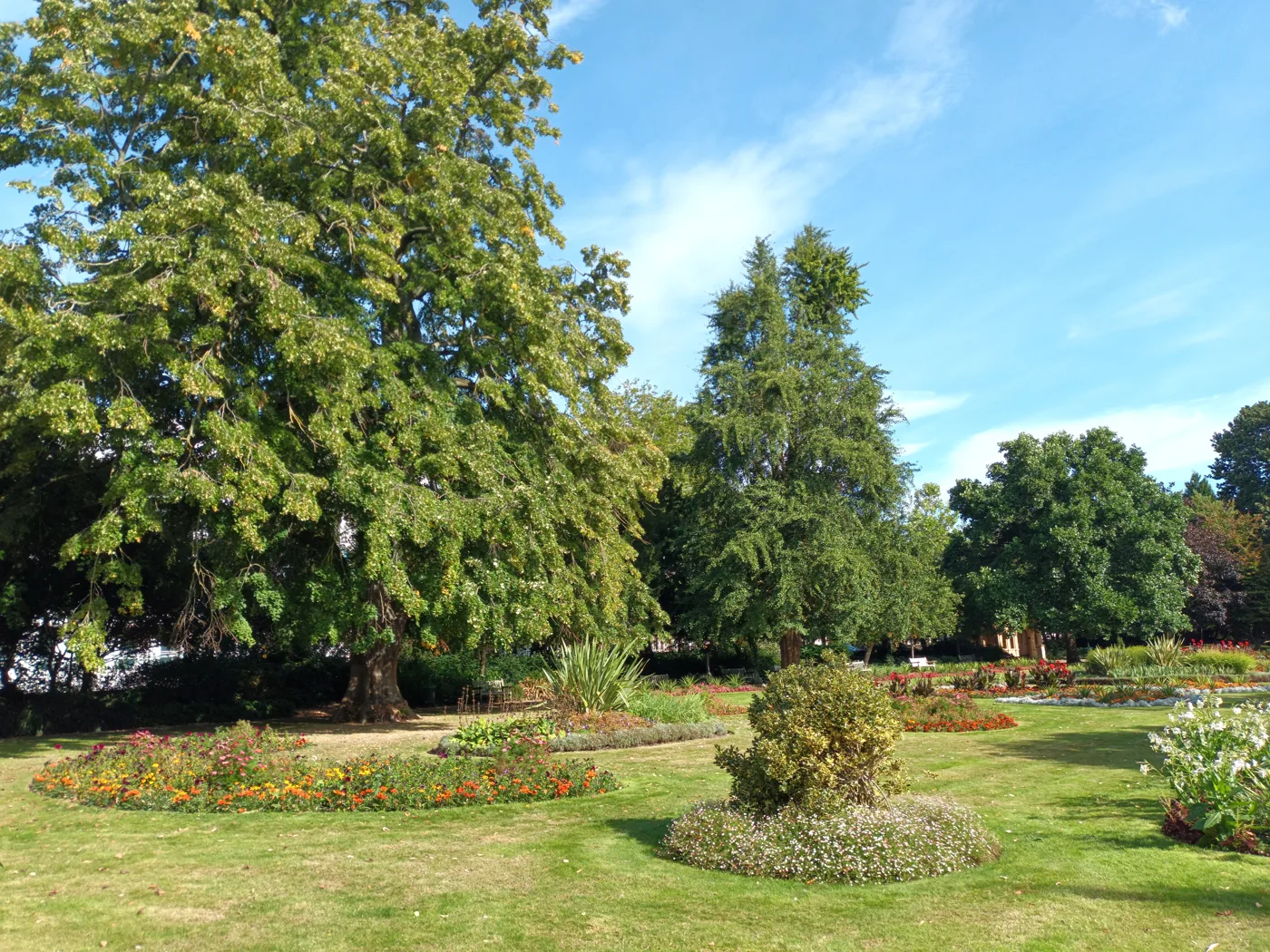

Warwick District Council has QR-labelled 23 of Jephson Gardens' most significant trees. Free to use, in a park with more than 140 species and 20 Green Flags.
Twenty-three of the most significant trees in Jephson Gardens now carry QR-code labels, so anyone walking through the park can point a phone at a trunk and read what the tree is and where it came from.
Warwick District Council’s Green Spaces team put the labels up. The council announced the trail on 2 September. It costs nothing to use and the gardens are open to the public.
The park holds more than 140 species of tree, drawn from mainland Europe, Asia, North America, South America, Australia and North Africa.
The two the council singles out
Councillor Will Roberts, the council’s Portfolio Holder for Neighbourhood, named two of the rarer specimens.
“Whilst few of the original trees remain, Jephson Gardens still contains many species dating from the late Victorian period or early twentieth century,” he said. “Now thanks to the power of technology, people walking through this beautiful park can discover the origins of some of its rarest and most unusual trees, including the Ginkgo and Caucasian Wingnut.”
Neither is a native British tree. The Ginkgo is the sole surviving species of an otherwise extinct order, and the Caucasian Wingnut is a relative of the walnut from the Caucasus and northern Iran.
A park that is on the national register
Jephson Gardens is not simply a municipal park. It forms part of the Spa Gardens at Royal Leamington Spa, entered on Historic England’s Register of Parks and Gardens of Special Historic Interest at grade II, list entry 1000498, first registered on 1 February 1986.
The registered area is a chain of riverside walks, gardens and parks about a kilometre long, created between 1814 and 1903, running through the centre of the town. Jephson Gardens is the stretch on the north bank of the Leam, 500 metres long and 100 metres wide, between Newbold Terrace and Willes Road.
The register entry sets out how it came about.
Around 1831 a meadow beside the Leam was fenced off and laid out to a design by J G Jackson, with planting by John Cullis, as Newbold Gardens, or Newbold Wood Walks. It was a commercial pleasure ground, not a public park. A subscription in 1846 let the lease be assigned to trustees, who improved the gardens and opened them to the public in 1847 as Jephson Gardens.
The name honours Dr Henry Jephson, who set up his practice in Leamington in 1828 and drew many visitors to the town on a regimen of moderate diet, exercise and taking the waters.
Several of the structures the trees stand among are separately listed at grade II:
- the Jephson Temple, a white marble statue of Dr Jephson by Peter Hollins, in a circular domed stone pavilion of 1848 to 1849 by David Squirhill
- the Aviary, which opened in 1899 as a buffet
- the Hitchman Fountain, a neo-gothic structure by J Cundall in memory of Dr Hitchman, who died in 1867
- the Willes Obelisk of 1875
- West Lodge, a Classical pair of 1847 by David Squirhill, and East Lodge on Willes Road, of the same year, by Jackson in what he called his Old English style
Twenty years of Green Flags
The gardens took their 20th consecutive Green Flag Award in July 2026, the longest run of any park in the district. The Pump Room Gardens took a fifth, and the nature reserves at Crackley Wood and Oakley Wood a ninth and tenth respectively, both managed with Warwickshire Wildlife Trust.
Jephson Gardens and the Pump Room Gardens also hold Green Heritage Site Accreditation, awarded with Historic England for the conservation of historic features.
What it means for you
- The labels are on 23 trees spread through the gardens. There is no set route and no booking: find a label, scan it with a phone camera, read the entry.
- It is a good free option for a wet afternoon with children, and it works in any season, though the Ginkgo is at its most obvious in late autumn when its leaves turn yellow.
- The gardens sit on Newbold Terrace, a short walk from the Parade and from the town’s car parks. Tariffs and the free two-hour bays are on our parking page, and there is more to do nearby on our things to do in Leamington page.
Sources
- New QR codes help visitors discover the trees of Jephson Gardens, Warwick District Council, 2 September 2026, for the 23 labelled trees, the 140-plus species, the Green Spaces team’s role and Councillor Roberts’ quotation.
- Historic England, Register of Parks and Gardens list entry 1000498, Spa Gardens, Royal Leamington Spa, grade II, first registered 1 February 1986, for the registered area, the dimensions of Jephson Gardens, the c.1831 Newbold Gardens layout by J G Jackson with planting by John Cullis, the 1846 subscription, the 1847 public opening, Dr Jephson’s 1828 arrival, and the dates and designers of the Temple, Aviary, Hitchman Fountain, Willes Obelisk and the two lodges.
- Council celebrates another quartet of Green Flag Awards, Warwick District Council, 16 July 2026, for the 20th consecutive Green Flag, the awards to the Pump Room Gardens, Crackley Wood and Oakley Wood, and the Green Heritage Site Accreditation.
Have your say