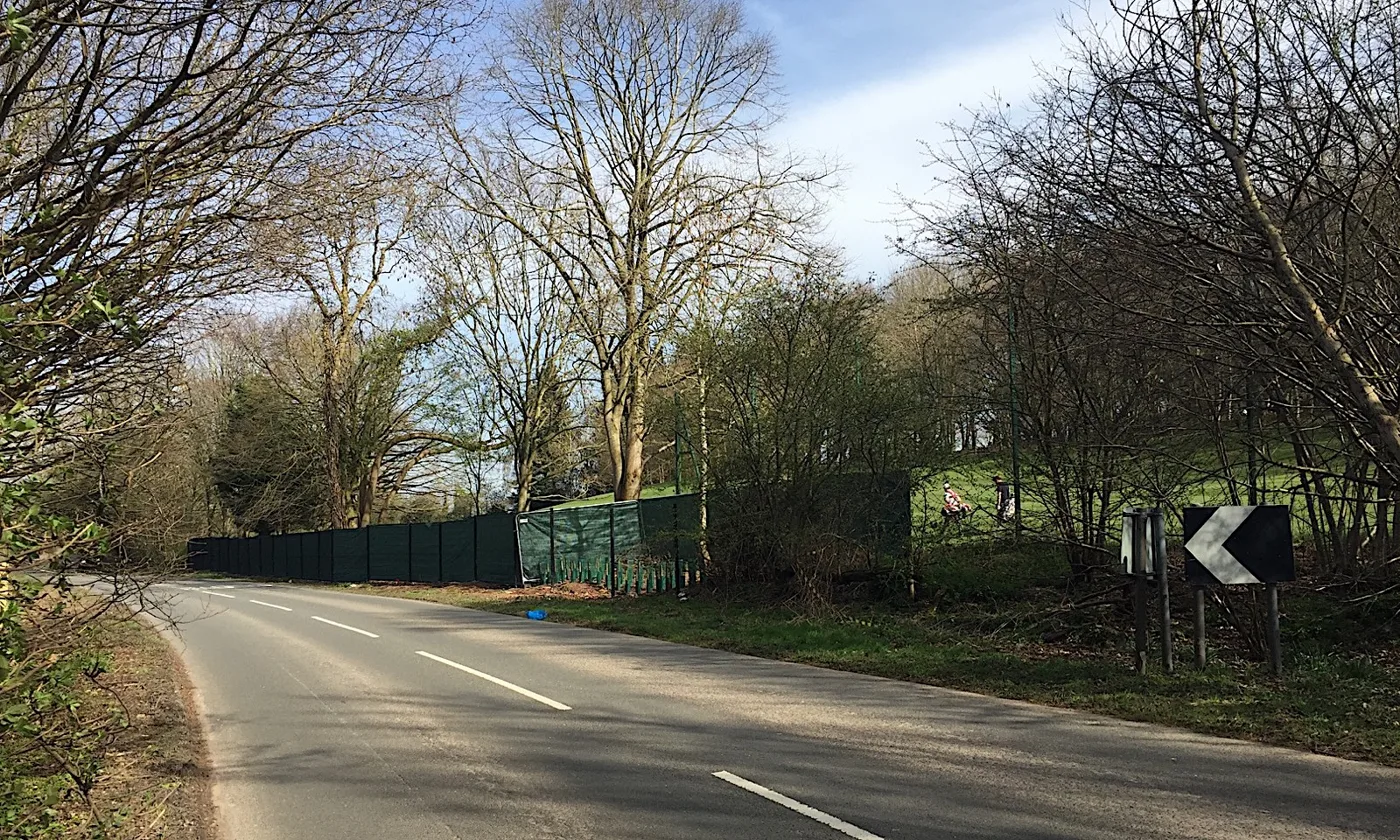

HS2's own report now rates Dalehouse Lane noise as major, day and night, where the Environmental Statement said moderate. The council rules by 20 October.
HS2 has asked Warwick District Council to approve the detailed design of the Kenilworth Cutting, and the noise report filed with it puts more Kenilworth homes above the noise threshold than the scheme’s own Environmental Statement predicted.
At Dalehouse Lane, the change is a jump in category. HS2’s contractor now records two major community noise impacts by day and two at night. The Environmental Statement predicted none, only two moderate ones.
The council has until Tuesday 20 October to decide.
What HS2 is asking for
The application, reference W/26/1247/HS2, was validated on 25 August 2026. It was submitted by Balfour Beatty Vinci on behalf of High Speed Two (HS2) Limited, and it is a request for approval of plans and specifications under Schedule 17 to the High Speed Rail (London to West Midlands) Act 2017.
The works it covers are:
- maintenance access stairs, including emergency egress
- engineering and landscape earthworks to form the cutting
- an ecological pond, land drainage and associated headwalls
- a GSM-R radio compound platform and maintenance access
- noise barriers beside the cutting and the railway
- boundary fencing and security fencing
The cutting starts immediately north of Dalehouse Lane and runs north west, passing under the existing Coventry to Leamington Spa railway and the A429 Kenilworth Road. HS2 puts Kenilworth town centre about 2km to the south west and Coventry city centre about 5km to the north east. The site edge sits directly next to Dalehouse Farm and the Grade II listed Dalehouse Farmhouse, and the cutting bisects the Kenilworth Greenway Local Wildlife Site.
The noise numbers
The application came with a Noise Demonstration Report covering the Stoneleigh, Glasshouse Wood and Canley stretch of the line. That report compares two designs: the mitigation assumed in the original Environmental Statement, and the mitigation now proposed, which it calls “The Design”.
The comparison that matters to residents is the number of homes at or above the lowest observed adverse effect level at night. That threshold is 40 decibels, measured over the eight hours from 11pm to 7am.
No home in any of the nine assessment areas is predicted to exceed the significant observed adverse effect level, which is 55 decibels at night. That is the level at which HS2 offers noise insulation.
The Dalehouse Lane change
Dalehouse Lane is a small assessment area, 14 dwellings, and its raw numbers barely move: 13 homes at or above the night threshold under the Environmental Statement design, 14 under the new one.
What changes is how the report classifies the effect on the community as a whole. Under the Environmental Statement design, Dalehouse Lane had no major impacts and two moderate ones, day and night. Under the design now submitted, it has two major impacts by day and two at night, and no moderate ones.
Two other areas pick up impacts that the Environmental Statement did not predict at all:
| Area | Dwellings | Impacts in the ES design | Impacts in the new design |
|---|---|---|---|
| Dalehouse Lane | 14 | 2 moderate day, 2 moderate night | 2 major day, 2 major night |
| Common Lane | 124 | none | 10 moderate night, 7 minor day |
| Coventry Road | 310 | none | 6 moderate night, 6 minor day |
The report footnotes the Common Lane figure to say the predicted level “fractionally exceeds” the threshold, so it does not treat those ten as a significant adverse effect.
What the barriers will look like
Across the Stoneleigh, Glasshouse Wood and Canley stretch the report proposes about 2.9km of acoustic screening in twelve sections. The tallest is a stand-alone absorptive wall 7 metres high and 280 metres long. Three further barriers stand 5 metres high, two stand 4 metres, and the rest are 2 metres to 2.1 metres.
The report also requires screening to continue underneath two overbridges, at 4 metres beneath the Green Overbridge and 5 metres beneath the South Accommodation Overbridge. No screening continuity is required under the Dalehouse Lane or A429 Kenilworth Road overbridges.
What the council can actually do
This is not an ordinary planning application. Section 20 of the 2017 Act already grants deemed planning permission for the railway. Schedule 17 lets the district council control only the design and external appearance of specific works, and only on limited grounds.
Those grounds are that the design ought to, and reasonably could, be modified:
- to preserve the local environment or local amenity
- to prevent or reduce prejudicial effects on road safety or the free flow of traffic
- to preserve a site of archaeological or historic interest, or of nature conservation value
- or, where the works are not a scheduled work, that they could reasonably go elsewhere within the permitted limits
Noise levels themselves are not on that list. The Secretary of State’s statutory guidance, quoted in HS2’s own written statement, tells councils they “should not through the exercise of Schedule 17 seek to modify controls already in place”, including the Environmental Minimum Requirements. HS2’s statement argues that on each ground there are no reasonably practicable modifications left to make.
What the county’s own officers said
Two Warwickshire County Council consultation responses are already on the file.
The archaeology response, from Senior Historic Environment Officer Anna Stocks on 2 September, is one line: no comments on the design.
The landscape response, from Landscape Officer Holly Colson on 3 September, is longer and more pointed. She requests no additional mitigation, and finds the planting types and locations in line with what the Environmental Statement assumed. But she notes that the submitted material gives “minimal detail” on the planting, and that without more she cannot comment on whether it will establish well enough to deliver the screening the assessment assumed.
She then quotes the Environmental Statement’s own verdict on this landscape. The cuttings and earthworks are partly responsible for a medium adverse change to the Stoneleigh Parklands Landscape Character Area, “due to the partial variance to the landform, loss of key characteristic woodland and sense of separation between Kenilworth and Coventry”. Planting is expected to integrate the railway by year 15 of operation.
What it means for you
If you live off Dalehouse Lane, Common Lane, Coventry Road or Birmingham Road in Kenilworth, the documents on this application are the most detailed public statement yet of how loud the railway is expected to be outside your house, and they are free to read.
- The application is W/26/1247/HS2 on Warwick District Council’s planning portal. All 17 documents are there, including the noise report, the barrier elevations and the landscape master plans.
- Comments go to planningenquiries@warwickdc.gov.uk, quoting the reference. The case officer is James Moulding.
- The council’s target date for a decision is 20 October 2026.
- Be aware of what the council can act on. Objecting that the trains will be noisy is unlikely to change anything, because Schedule 17 does not give the council that power. Objections about the appearance and design of a 7 metre wall, or about whether the planting is detailed enough to screen it, land on grounds the council can use.
For other applications in the district, see our Leamington planning news page.
Sources
- Warwick District Council planning application W/26/1247/HS2, Kenilworth Cutting, Kenilworth Road, Kenilworth, for the description of works, the 25 August 2026 validation date, the 20 October 2026 target date, the case officer, the applicant and agent, and the document list.
- Schedule 17 Plans and Specifications Written Statement (document 1MC08-BBV_MSD-PL-REP-NS01_NL03-100042), filed with the application, for the site location, the distances to Kenilworth and Coventry, the Dalehouse Farmhouse and Kenilworth Greenway descriptions, the Schedule 17 grounds for refusal and the statutory guidance quotation.
- Noise Demonstration Report for Stoneleigh, Glasshouse Wood, Canley (document 1MC08-BBV_MSD-EV-REP-NS01_NL03-100088, revision C07), filed with the application, for every noise figure quoted: the barrier heights and lengths, the LOAEL and SOAEL values, the per-area dwelling counts, and tables 15 to 42 comparing the submitted design with the Environmental Statement design.
- Warwickshire County Council landscape consultation response of 3 September 2026, and archaeology consultation response of 2 September 2026, both published on the application file.
- Cover letter from Balfour Beatty Vinci to Warwick District Council, 25 August 2026, HS2 reference WAC.PS.10007, for the submission contents and the safeguarding position.
Have your say